

How To Slim Calves
Last updated: July 2026 · 5 min read
We write a lot about getting lean legs and slimming muscular thighs, but rarely about calves. There's a reason for that: calves are one of the hardest areas to change.
Still, we get asked constantly how to make calves smaller — so here's a straight answer. Let's start with why your calves might be bigger in the first place, because the cause determines what (if anything) you can do about it.
What causes bigger calves?
1. Genetics
This is the hard part. Calf size is largely genetic. Look at your parents' and siblings' calves — do they look like yours? If you were born with larger calves and haven't done much to change them, you likely won't see dramatic changes, though small improvements are possible.
2. Fat
If your calf size comes from fat, losing weight overall will help slim them. Keep in mind that for many women the legs are the last place fat comes off, so it takes patience.
3. Muscle
If you've done a lot of calf-focused work — especially heavy or high-impact exercise — your calves may have grown from muscle, particularly if you're genetically prone to it. In that case, cutting back on those exercises can help the muscle shrink over time, especially if your calves are "pumped up" from training.
Are my calves fat or muscle?
Here's a quick test: flex your calf. The hard part is muscle; the softer layer over it is fat.
Body-fat percentage can also give you a rough idea. According to the American Council on Exercise, female athletes typically sit around 14–20% body fat, while "fit" active women fall around 21–24%.
Why did my calves get bigger from working out?

Certain exercises build calf muscle fast, so if your calves were slim before and grew after you started training, exercise is likely the cause — and the good news is you can usually reverse it. Below are the exercises to cut back on, followed by what to do instead.
Step 1: Exercises to avoid if you want slimmer calves
Every exercise below is good for overall fitness and fat loss. But if slimming your calves is the priority, ease off these:
Incline cardio
Running builds some calf muscle, but it's so good for slimming your legs overall that we wouldn't tell you to quit. Instead, run on flat ground — inclines increase calf size. In the gym, skip the StairMaster and treadmill inclines. Steady-state running builds far less muscle than sprinting, so favor that. And if you'd rather not run at all, flat-surface walking slims your legs without adding calf size.
Hill sprints and uphill work
Anything uphill builds calf muscle — hill sprints, frequent hiking, and stair machines included.
Skipping (jump rope)
People often ask if jump rope slims the legs. It doesn't — it works the calves hard and can bulk them quickly if you're prone to it. It's a great exercise otherwise, so keep it if calf size isn't a concern.
Plyometrics and HIIT
Jumping movements load the calves and can build them. You don't have to drop HIIT entirely, but go easy on lower-body plyometrics — jump squats, jump lunges, burpees, and anything with a heavy landing.
Step 2: Do more low-intensity cardio
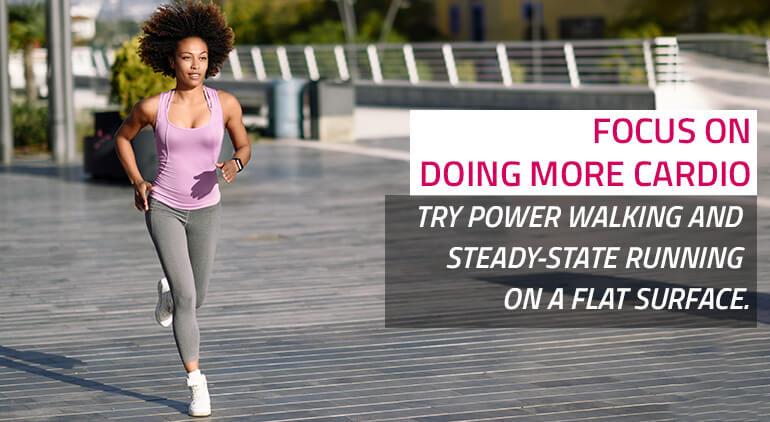
Once you've cut the muscle-building work, replace it with low-intensity cardio. It burns fat, lowers overall body mass, and helps your calves look smaller without adding size. Try power walking, steady-state running (both on flat ground), or swimming.
Use the treadmill
Many women say their calves look smaller when they run on a treadmill. The likely reason: the belt moves under you, so you push off the ground less than you would outdoors. Results vary by person, so see what works for you.
Adjust your running form
Don't run on your toes — that overworks the calves. Use a heel-to-toe strike and supportive shoes.
Step 3: Focus on losing weight overall
Losing weight sheds both fat and muscle, which can make your calves noticeably thinner. But you can't spot-reduce, so where you slim down first depends on your body. For example, some people lose from the upper body faster than the lower.
The bottom line: diet drives weight loss, and exercise supports it. To slim your calves, stay in a calorie deficit and be patient — the legs are often the last to change.